
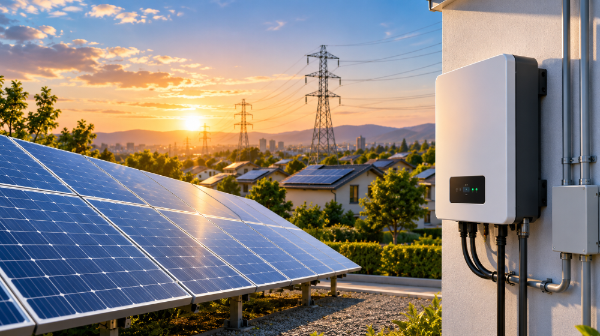
As solar power systems become more common, safely connecting multiple photovoltaic installations to an electrical grid becomes increasingly important. One technical challenge is islanding, a condition in which a solar power system can continue supplying electricity to part of a grid after the main utility supply has been interrupted. In this context, AICOT refers to OMRON’s Anti-Islanding Control Technology, developed for situations where multiple photovoltaic systems are connected to the same grid. The technology was created to help detect islanding and reduce problems caused by interactions between multiple solar power conditioners.
What Does AICOT Mean?
AICOT is an acronym for Anti-Islanding Control Technology. OMRON describes it as a technology brand for preventing dangerous islanding operation in multiple-unit photovoltaic systems. It was developed specifically to address challenges that can arise when numerous solar power systems operate close together and are connected to the same electrical network.
The distinction is important because AICOT is not the name of a solar panel, battery, or complete solar installation. Instead, it refers to a control and detection technology associated with photovoltaic power conditioners, commonly known as solar inverters. Its purpose is related to electrical-grid protection and the safe behavior of connected solar equipment.
The term can also refer to unrelated organizations or projects, including a European artificial-intelligence cybersecurity project. Therefore, identifying the surrounding context is essential when researching the word AICOT.
Why Is Anti-Islanding Important?
A solar inverter connected to a utility grid normally operates while the grid is energized. If the utility supply fails, however, the solar installation must recognize that change and respond appropriately. An unintended island can create safety and equipment concerns because a section of electrical infrastructure may remain energized when utility workers expect it to be disconnected.
The problem becomes more complicated when many photovoltaic systems are installed in the same area. OMRON explains that interactions between multiple systems can interfere with conventional islanding detection methods. This created a technical challenge for areas interested in installing solar power across multiple homes or buildings.
Effective anti-islanding control therefore plays an important role in connecting distributed solar generation to electrical networks while maintaining appropriate protection.
How Does AICOT Work?
The technical approach behind AICOT involves detecting changes in electrical conditions associated with islanding. OMRON technical documentation describes the technology as an active islanding-detection method using frequency feedback with step injection of reactive power. In simple terms, the system monitors the behavior of the electrical network and uses a controlled electrical response to help identify whether the normal grid connection remains present.
This approach was designed to address situations involving multiple photovoltaic systems operating together. Rather than treating each solar inverter as an isolated installation, the technology considers the difficulties that can occur when several systems interact through the same electrical network.
The underlying objective is straightforward: detect an abnormal grid condition quickly enough for the solar equipment to respond appropriately and avoid continuing unintended islanded operation.
AICOT and Multiple Solar Installations
One of the main reasons this technology attracted attention was the growth of clustered photovoltaic installations. OMRON’s historical documentation describes development work involving a large residential solar project in Japan, where numerous homes were equipped with photovoltaic systems. The project demonstrated the practical challenges of operating many solar installations within one community.
Traditional approaches could require testing to determine whether multiple systems interfered with one another’s islanding detection. OMRON developed its technology to address this issue specifically. According to the company, the approach could help avoid certain interference tests and reduce limitations associated with installing numerous photovoltaic systems in a concentrated area.
Development and Introduction of the Technology
OMRON’s published history provides useful information about the development of AICOT. The company reports that development work successfully produced the technology in 2008 after several years of research. OMRON subsequently introduced a photovoltaic inverter equipped with AICOT in 2011.
OMRON’s corporate history also identifies 2011 as the year it launched an industry-first power conditioner equipped with anti-islanding control technology under the AICOT brand.
The technology was developed in connection with Japan’s growing interest in distributed solar generation. The goal was not simply to create another inverter feature, but to address a specific electrical-protection challenge that could become more significant as the number of connected photovoltaic systems increased.
Detection Speed and Grid Protection
Speed is an important consideration in islanding detection. OMRON states that its AICOT-equipped systems could detect islanding within approximately 0.2 seconds based on changes in frequency. This figure comes from OMRON’s own description of the technology and should therefore be understood in the context of the company’s documented system and testing claims rather than as a universal performance figure for every modern solar inverter.
Fast detection can be valuable because an electrical network should not remain unintentionally energized after the utility supply has been interrupted. Proper anti-islanding behavior helps maintain the separation expected during a grid outage.
The actual protection behavior of any modern photovoltaic system still depends on its inverter design, applicable standards, installation conditions, and grid requirements.
AICOT’s Role in Solar Power Development
The importance of AICOT is closely connected to the broader growth of distributed renewable energy. Solar panels generate direct current, while grid-connected systems use inverters or power conditioners to convert and manage electrical power for connection to an alternating-current network.
As more homes and buildings install solar generation, many individual systems can operate within the same local electrical infrastructure. This creates technical requirements that do not arise in exactly the same way with a single isolated installation.
OMRON has described AICOT as a technology intended to support the use of photovoltaic systems in concentrated installations, including residential communities. The company also reports that it released the technology’s patent to encourage broader adoption of solar power.
Why the Term Can Be Confusing
The word AICOT does not have one universal meaning. OMRON uses the term for Anti-Islanding Control Technology, but other organizations currently use similar naming for completely different purposes.
For example, the AICOT Project in Europe describes an AI-driven cybersecurity platform intended for operational technology environments in critical infrastructure. Its project materials mention machine learning, anomaly detection, operational-technology protocol analysis, threat intelligence, and real-time monitoring.
There is also a German business using the name aicot for artificial-intelligence consulting, training, and related services aimed at small and medium-sized businesses and independent professionals.
For that reason, readers should not assume that every reference to AICOT concerns solar technology. The surrounding subject, organization, and website should always be checked before interpreting the term.
What Readers Should Know About AICOT Today
The most reliable information about OMRON’s AICOT comes from OMRON’s own technical and corporate publications. These sources consistently identify it with anti-islanding protection for multiple photovoltaic systems.
It is also important not to treat older descriptions as specifications for every current solar inverter. Photovoltaic technology, grid codes, inverter designs, and safety requirements continue to evolve. AICOT is best understood as a specific technology developed to address a particular challenge in grid-connected solar generation.
For anyone researching a solar installation, the practical questions should include the inverter’s current certifications, applicable electrical standards, grid-connection requirements, and documented protection functions rather than relying on the presence of a particular brand name alone.
Conclusion
AICOT, in OMRON’s documented usage, stands for Anti-Islanding Control Technology and was developed to address islanding risks in grid-connected photovoltaic systems, particularly where multiple solar installations operate close together. Its development was linked to Japan’s expanding distributed-solar market, and OMRON introduced an AICOT-equipped photovoltaic inverter in 2011. The term is not exclusive to solar technology, however, because unrelated organizations and projects also use the name. Understanding the context is therefore essential when researching AICOT or evaluating information about the technology.
FAQs
1. What does AICOT stand for?
In OMRON’s solar technology, AICOT stands for Anti-Islanding Control Technology. It is designed to help prevent unintended islanding in multiple-unit photovoltaic power systems.
2. What is islanding in a solar power system?
Islanding occurs when a grid-connected solar installation continues supplying electricity to an isolated section after the normal utility supply has been interrupted.
3. Who developed AICOT?
OMRON developed the AICOT technology for photovoltaic power systems. OMRON reports that development was successfully completed in 2008, followed by commercial introduction in 2011.
4. Is AICOT the same as a solar inverter?
No. AICOT is a control technology associated with photovoltaic power conditioners or inverters. It is designed for islanding detection rather than being a separate solar-generation device.
5. Does AICOT have meanings outside solar energy?
Yes. AICOT is also used by unrelated organizations and projects, including a European AI-based operational-technology cybersecurity project. The meaning depends on the context.