
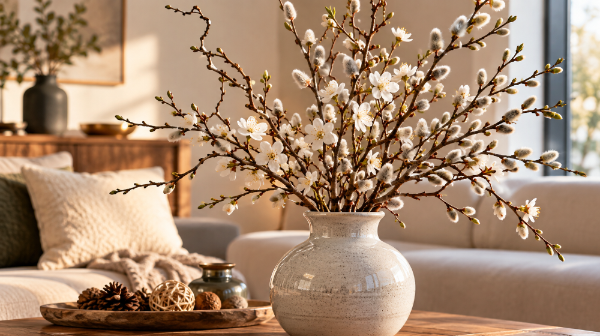
The word pyntekvister appears increasingly in online home-decor discussions as a name for decorative twigs or branches arranged for visual appeal. However, the terminology deserves a little clarification. Norwegian dictionaries confirm that kvist means a twig or small branch, while kvister is its plural form. Online sources commonly interpret pyntekvister as a combination associated with decorating branches, but there is limited authoritative evidence establishing it as a formal, standalone Scandinavian design tradition. In practical terms, the idea is easy to understand: attractive branches can be placed in vases or other displays to introduce natural shapes, texture, height, and seasonal character into an interior.
What Does Pyntekvister Mean?
The most useful way to understand pyntekvister is as a descriptive term for decorative branches or twigs. The Norwegian word kvist is documented as meaning “twig,” while kvister is the plural form. The first part, pynte, is associated with decorating or adorning in Scandinavian-language usage.
It is worth separating the meaning of the individual words from claims about a formal decorating tradition. Several recent websites describe pyntekvister as a Scandinavian home-decor concept, but a review of available reference material does not provide strong evidence that it represents a formally named historical tradition. Therefore, readers should treat the term primarily as a useful description of decorative branch arrangements rather than assume a specific cultural history.
Why Decorative Branches Work in Interior Design
Branches have a naturally irregular structure that can add visual interest without introducing complicated patterns or large decorative objects. Their height can draw attention upward, while their curves and smaller twigs create lines that contrast with furniture, walls, and other straight surfaces.
A branch arrangement can also introduce a natural material into an otherwise highly finished room. Bare wood, bark, buds, leaves, or flowers each provide a different appearance. Because the basic form is simple, decorative branches can work with contemporary, rustic, minimalist, or seasonal interiors without requiring a complete change to the surrounding decoration.
The effect depends largely on proportion. A tall arrangement may suit a spacious corner, while shorter branches can work better on a dining table, shelf, or console.
Choosing Branches for a Decorative Arrangement
The right branch depends on the look you want and the conditions in which the arrangement will be displayed. Fresh branches can provide buds, foliage, or flowers, while dried branches offer a longer-lasting display with a more permanent appearance.
When selecting natural branches, look for interesting shapes, healthy-looking material, and a size that suits the container. Very thin branches can disappear visually in a large room, whereas extremely large branches may overwhelm a small table.
Artificial branches are another option when someone wants a consistent appearance without dealing with fresh plant material. They can be useful where natural branches are difficult to source or where a display needs to remain unchanged for a long period. The important consideration is that the material should suit the surrounding space rather than simply being chosen because it is decorative.
How to Arrange Decorative Branches
Creating an attractive arrangement does not require complicated techniques. Start with an appropriate vase or container that can provide enough stability for the branches. A narrow container may help hold a small group upright, while a wider vessel can accommodate a more open arrangement.
Place the longest or most visually distinctive branches first, then add smaller pieces where they improve the overall shape. Avoid making every branch the same height or forcing the stems into perfect symmetry. Natural variation is often part of the appeal.
For a table arrangement, keep the overall height appropriate for the space so the display does not interfere with conversation or visibility. In a floor vase, taller branches can become a stronger architectural element. The goal is balance rather than simply filling the container.
Seasonal Decorating With Branches
One advantage of decorative branches is their flexibility throughout the year. Bare branches can create a restrained winter display, while branches carrying fresh leaves can provide a brighter spring or summer appearance. Flowering branches can introduce color when they are naturally available.
Small seasonal ornaments can also change the character of an existing arrangement. Rather than replacing the entire display, someone can update a few details to suit a particular occasion or season.
However, seasonal decoration should not be confused with an established tradition specifically called pyntekvister. Available evidence supports the broader practice of using branches decoratively, but claims about a distinct ancient or historically defined tradition under that exact name are not well established. Keeping that distinction clear makes the subject easier to understand.
Fresh, Dried, or Artificial Branches?
Each type has practical advantages. Fresh branches can provide changing natural details such as developing buds, leaves, or flowers. They may require water and more regular attention, particularly when they are being used as living cut material.
Dried branches are generally suited to arrangements intended to remain in place for longer periods. Their texture and muted appearance can work particularly well with neutral interiors. They should still be handled carefully because some dried plant materials can shed small pieces.
Artificial branches provide another approach. They require little routine maintenance and can maintain a consistent appearance. On the other hand, their visual quality varies considerably, so choosing realistic materials and natural-looking shapes is important.
There is no universally correct option. The best choice depends on the desired appearance, maintenance level, availability, and location of the arrangement.
Practical Tips for Displaying Branches at Home
A few basic considerations can make a branch display safer and more attractive. First, use a stable container, especially when working with tall or heavy branches. A lightweight vase can easily become unstable if the branches extend far beyond its base.
Consider the surrounding furniture as well. A dramatic arrangement may work well against an uncluttered wall, whereas a busy shelf may benefit from a smaller display. Natural branches also look different under various types of lighting, so viewing the arrangement during both daytime and evening can help reveal whether its shape works in the room.
If using fresh branches in water, keep the container clean and follow appropriate care instructions for the particular plant material. If using dried branches, keep them away from flames and other direct heat sources. These simple precautions can help preserve the arrangement while reducing avoidable household risks.
Common Misunderstandings About the Term
The biggest misunderstanding is treating pyntekvister as though it has one universally documented definition and a clearly established historical origin. Current online material does not support that level of certainty. Several websites use the term to describe decorative branches, but the available evidence is stronger for the meanings of the underlying Scandinavian words than for the compound itself.
Another misconception is that decorative branches must follow one particular Scandinavian decorating method. In reality, branches can be displayed in many ways, and their use is not limited to one interior style.
For readers researching the term, this distinction is useful. It allows them to appreciate the practical decorating idea without repeating unsupported claims about history, cultural significance, or a formal design movement.
A Simple Approach to Natural Home Decor
The appeal of decorative branches comes from their simplicity. Instead of relying on many small decorative objects, one carefully selected branch or a small group can provide height, texture, and an organic shape.
This approach can also make it easier to change a room gradually. A vase can remain the same while its contents are changed according to season or personal preference. Similarly, a dried arrangement can stay in place for an extended period without becoming the central focus of the room.
For people who enjoy understated interiors, this type of decoration offers a straightforward way to introduce natural materials. The result does not have to be elaborate. In many cases, a restrained arrangement allows the form of the branches themselves to remain the main visual feature.
Conclusion
Pyntekvister is best understood as an online term associated with decorative twigs or branches, although the exact compound is not as firmly documented in authoritative dictionaries as its component word kvist, meaning twig or small branch. Regardless of terminology, decorative branches are a simple and adaptable way to bring natural shapes and textures into an interior. Whether fresh, dried, or artificial, they can be arranged according to the size, lighting, style, and practical needs of a space. Keeping the documented facts separate from unsupported historical claims makes it possible to enjoy the decorating idea without overstating what is known about the term itself.
FAQs
1. What does pyntekvister mean?
Pyntekvister is commonly used online to describe decorative twigs or branches. The Norwegian word kvist means twig or small branch, with kvister as its plural.
2. Is pyntekvister an established Norwegian word?
The component word kvist is clearly documented in Norwegian dictionaries, but reliable reference evidence establishing pyntekvister as a formal standalone dictionary term is limited.
3. What branches can be used for decoration?
Fresh, dried, and artificial branches can all be decorative. Suitable choices depend on availability, appearance, size, desired maintenance, and whether the arrangement is intended to be temporary or long-lasting.
4. How should decorative branches be displayed?
Choose a stable vase or container, select branches appropriate to the room’s scale, and arrange different heights and shapes naturally. Avoid overcrowding the container or making the display unnecessarily symmetrical.
5. Can decorative branches be changed seasonally?
Yes. A basic branch arrangement can be adapted with naturally changing foliage, flowers, or suitable seasonal decorations. This allows one container to serve different decorative purposes throughout the year.