
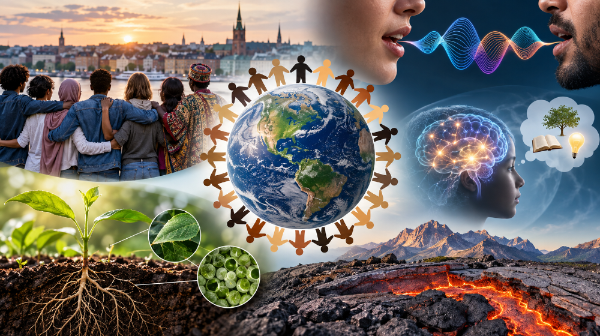
The Norwegian word assimilasjon broadly refers to a process of becoming more alike, being incorporated into something existing, or transforming something so that it fits into an established system. However, its exact meaning depends heavily on context. Norwegian dictionaries identify uses in areas including linguistics, society, geology, physiology, psychology, and botany. The word ultimately comes from Latin assimilare, meaning “to make similar.” Understanding these different meanings matters because a discussion about cultural assimilation describes something quite different from assimilation of speech sounds or nutrients.
What Does Assimilasjon Mean?
At its broadest level, the term describes adaptation, incorporation, or transformation toward something already existing. Bokmålsordboka, maintained by the Language Council of Norway and the University of Bergen, also defines it as a politically driven or self-driven process in which a minority group becomes more similar to a majority.
The word is therefore not restricted to one academic subject. It can describe changes among people and cultures, interactions between speech sounds, the processing of substances by organisms, and certain processes in psychology and geology. The surrounding context is essential for determining which meaning is intended.
Assimilation in Linguistics
In linguistics, assimilation happens when one speech sound influences another so that the sounds become partly or completely alike. Store norske leksikon explains that the phenomenon occurs naturally because the organs used for speech remain in continuous motion, allowing neighboring sounds to influence each other.
This process is common in ordinary spoken language and may happen without being reflected in spelling. Linguistic assimilation can also become established through historical sound change. As a result, linguists study it both as an everyday feature of pronunciation and as a mechanism that helps explain how languages and words change over time.
Contact and Distant Assimilation
Linguists distinguish between contact assimilation and distant assimilation. Contact assimilation occurs when the sounds influencing one another are directly adjacent. Distant assimilation occurs when there is space between the affected sounds.
Another distinction concerns the direction of influence. In regressive assimilation, a later sound affects an earlier one. In progressive assimilation, an earlier sound influences a sound that follows it.
These categories give linguists a precise way to describe pronunciation patterns rather than treating changes in spoken language as random variations.
Assimilation in Society and Culture
In sociology, assimilasjon can describe a process in which members of a minority increasingly adopt the language, norms, values, or cultural practices of a majority. Store norske leksikon describes assimilation as a minority-policy approach in which people or groups may be expected to give up aspects of their cultural identity in order to adapt to the majority culture.
The term can refer to processes that occur gradually as well as deliberate policies. Because state-directed assimilation has historically involved pressure or coercion in some contexts, the concept carries important political, cultural, and human-rights implications.
Assimilation Versus Integration
Assimilation and integration should not automatically be treated as synonyms. In a classic assimilation model, minority members adapt primarily toward the established majority culture. Cultural differences may consequently become less visible over time.
Integration generally allows greater room for people to participate in shared institutions and society while retaining aspects of their cultural background and identity. Store norske leksikon notes that modern concepts of integration developed partly in response to earlier assimilation approaches and placed greater emphasis on cultural roots, identity, rights, and pluralism.
In practice, however, social processes are complex and do not always fit neatly into either category.
Historical Context in Norway
Norway provides an important historical context for understanding cultural assimilation. Norwegian authorities pursued a Norwegianization policy toward the Sámi population, with assimilation as a goal. According to Store norske leksikon, Norwegian remained the sole language of instruction in schools in Sámi areas until the late 1970s, and public measures contributed to language loss and marginalization.
This history illustrates why discussions about assimilation can involve much more than people voluntarily adopting new customs. When governments or institutions impose cultural change, questions arise concerning power, language rights, identity, education, and minority protections.
Assimilation in Psychology
The concept has another meaning in psychology. In Jean Piaget’s theory of cognitive development, assimilation involves understanding new experiences through knowledge or mental frameworks that a person already possesses.
Imagine a young child who already has a mental category for birds and encounters a previously unseen bird species. The child may initially understand the unfamiliar animal by fitting it into that existing category.
This psychological meaning differs significantly from cultural assimilation. Here, the central issue is how information and experiences are incorporated into existing ways of understanding the world rather than how cultural groups relate to one another.
Assimilation in Biology and Physiology
The concept also appears in the life sciences. In biology, assimilation can describe organisms taking up substances and transforming them into components of themselves. In plants, this includes metabolic processes in which inorganic substances are incorporated and converted into organic compounds. Carbon dioxide, for example, is incorporated through photosynthesis and used in producing sugars.
In physiology, assimilation has a more specific nutritional meaning: digested and absorbed nutrients are converted into components incorporated into cells and tissues.
Although these biological meanings differ from social ones, they retain the underlying idea of incorporating something into an existing system.
Other Academic Uses of the Term
Norwegian dictionaries show that the term extends beyond linguistics, sociology, psychology, and biology. It is also used in geology. Det Norske Akademis ordbok describes geological assimilation as the incorporation or dissolution of surrounding or enclosed rock material into molten magma.
This range of meanings explains why interpreting the word without context can be misleading. A geology textbook, psychology course, language lesson, and discussion of minority policy may all use the same Norwegian term while describing substantially different processes.
The common thread is similarity, incorporation, or adaptation, but the mechanisms and consequences vary greatly between disciplines.
Why Context Matters
When encountering assimilasjon, readers should first identify the subject being discussed. References to pronunciation, consonants, or speech normally indicate the linguistic meaning. Discussions involving minorities, language policy, migration, identity, or majority culture usually involve the social meaning.
References to cognition or mental frameworks may indicate psychology, while nutrients, plants, tissues, or metabolism point toward biological or physiological meanings.
This simple contextual approach prevents confusion. It is particularly important with multidisciplinary terms because a short dictionary translation such as “assimilation” cannot by itself communicate all of the concept’s academic, historical, and social implications.
Conclusion
Assimilasjon is a well-established Norwegian term with several legitimate meanings rather than a concept belonging to one field alone. Its central idea involves becoming similar, incorporating something, or adapting something to an existing structure. In linguistics, it describes sounds becoming more alike; in social contexts, it concerns relationships between minorities and majority cultures; in psychology, it can describe incorporating experiences into existing knowledge; and in biology and physiology, it refers to forms of material incorporation or transformation. The most reliable way to understand the term is therefore to consider the discipline and context in which it appears.
FAQs
1. What does assimilasjon mean in English?
The closest English translation is “assimilation.” Its precise meaning depends on context and can involve cultural adaptation, sound changes, cognitive processes, or biological incorporation.
2. Is assimilation the same as integration?
Not exactly. Assimilation generally emphasizes becoming more like an established majority, while integration can allow participation in society alongside continued cultural differences and identities.
3. What does assimilation mean in linguistics?
It occurs when one speech sound influences another so that the two become partly or completely alike. It is a normal phenomenon in natural speech.
4. Is assimilation always a cultural process?
No. The term is also established in linguistics, psychology, physiology, botany, biology, and geology, where it describes different forms of incorporation, similarity, or transformation.
5. What is the opposite of linguistic assimilation?
Dissimilation is the opposite process: one of two similar speech sounds changes so that the sounds become less alike rather than more similar.