
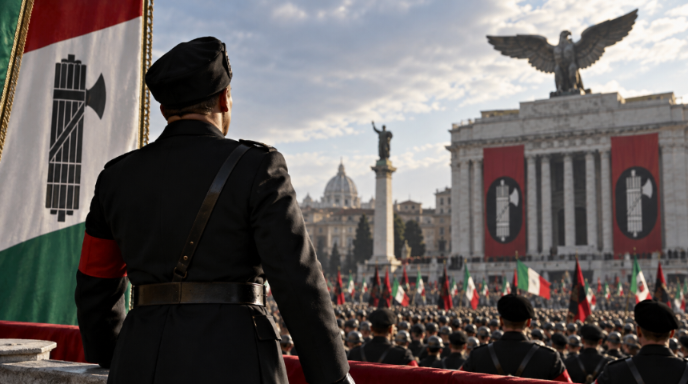
The Danish word “fascisterne” means “the fascists” in English and is commonly used when discussing people or groups associated with fascism. The term is connected to one of the most important and controversial political movements of the twentieth century. Fascism emerged in Italy after the First World War, most famously under Benito Mussolini, and developed into an authoritarian political system that rejected liberal democracy, promoted intense nationalism, and used political violence and repression. Its influence extended beyond Italy, affecting political movements across Europe. Understanding the word therefore requires more than a simple translation: it requires understanding the historical ideology, the conditions that helped it grow, and its lasting impact.
What Does “Fascisterne” Mean?
The word fascisterne is Danish and can be translated directly as “the fascists.” It refers to people who supported or belonged to fascist movements, although the precise meaning depends on the historical context in which the word is used.
The word “fascism” itself comes from the Italian fascismo, which is associated with fasces, an ancient Roman symbol consisting of bound rods around an axe. The symbol represented authority and strength and was adopted by Italian fascists as part of their political imagery.
Historically, fascists were associated with strong nationalism, hostility toward socialism and communism, rejection of parliamentary democracy, and a preference for authoritarian government. Fascist movements also frequently relied on political mobilization, propaganda, discipline, and violence against opponents.
Why Context Matters
Not every authoritarian or nationalist political movement can automatically be described as fascist. Historians have debated how broadly the term should be applied because different movements developed under different national and historical conditions. This is particularly important when comparing Italian fascism with German Nazism or other right-wing movements.
The Origins of Fascism in Italy
Modern fascism is most closely associated with Benito Mussolini and Italy after the First World War. Mussolini founded the first fascist fighting organization, Fasci di combattimento, in Milan on March 23, 1919. The early movement attracted veterans and others who were dissatisfied with the political and social situation of postwar Italy.
Italy faced considerable political conflict and social instability during this period. Fascist groups presented themselves as a force capable of restoring national strength and order. They were strongly opposed to socialism and communism and developed a political style that emphasized action, nationalism, and organized violence.
The movement grew rapidly. In October 1922, fascists carried out the March on Rome. King Victor Emmanuel III subsequently asked Mussolini to form a government. Fascists gradually transformed their political position into a dictatorship, and by the middle of the 1920s the democratic political system had been substantially dismantled.
How Fascist Rule Worked
Once Mussolini’s movement gained control, the political system changed significantly. The fascist government sought to place the interests of the individual and competing social groups beneath the authority of the state and the nation.
Political opposition was restricted or suppressed. Censorship became important, and the fascist party became the only permitted political party. The regime also developed a corporatist system in which employers and workers were organized into state-controlled structures intended to replace independent class-based political conflict.
Violence was an important part of the earlier fascist movement and remained connected to its political history. Fascist squads attacked political opponents, particularly socialists and communists. The murder of socialist politician Giacomo Matteotti in 1924 became one of the most notorious examples of the violence surrounding the Italian fascist regime.
Nationalism and the State
Fascist ideology placed enormous importance on national unity and state power. Individual interests were expected to serve the nation rather than compete with it. The regime also used Roman history and symbols to present Italy as heir to a powerful imperial tradition.
This combination of nationalism, authoritarianism, political mobilization, and suppression of opposition became central to the historical understanding of Italian fascism.
Fascism Beyond Italy
Fascism did not remain an exclusively Italian phenomenon. During the interwar period, fascist and related radical-right movements appeared in several European countries.
Germany provides the most significant comparison. Adolf Hitler and the Nazi movement shared important characteristics with Italian fascism, including extreme nationalism, anti-democratic politics, political violence, propaganda, and authoritarian leadership. However, Nazism also had a particularly central racial and antisemitic ideology, making it distinct from Italian fascism in important ways.
Historians therefore generally avoid treating every fascist or authoritarian movement as identical. Political conditions, racial ideology, nationalism, religion, economic circumstances, and relationships with existing institutions varied from country to country.
The Role of Political Crisis
The growth of fascist movements was influenced by the severe political and economic tensions of the interwar period. The First World War had destabilized European societies, while the economic crisis that followed the Wall Street Crash of 1929 created additional unemployment, insecurity, and political conflict.
These conditions did not automatically produce fascism. Different countries responded differently to crisis. In Denmark, for example, political compromise and democratic institutions helped the country navigate the economic difficulties of the 1930s.
Fascist Movements and Denmark
Denmark was not ruled by a fascist government comparable to Mussolini’s Italy. Nevertheless, fascist and Nazi-inspired political movements existed in Denmark during the interwar period.
The Danish political environment of the 1930s also experienced political tensions, demonstrations, uniforms, and organized groups influenced to varying degrees by authoritarian and militaristic movements elsewhere in Europe. Danish authorities introduced measures intended to limit political violence and organized militarism.
One example was the Danish uniforms ban adopted in April 1933. Supporters argued that political uniforms contributed to unrest and that preventive measures were necessary to prevent antidemocratic methods from becoming more established.
This history shows why discussions of fascisterne in a Danish context need to distinguish between fascism as an international ideology, Danish fascist organizations, and the broader presence of authoritarian or militaristic political ideas.
Fascism, Violence, and Political Opposition
Political violence was not simply an accidental feature of fascist history. In interwar Italy, fascist squads used physical attacks against political opponents as part of their struggle for influence. Their violence helped intimidate opponents and contributed to the weakening of democratic political life.
The existence of organized political violence also encouraged resistance. Antifascism developed as opposition to fascist politics and later became associated with resistance to Nazism and other authoritarian regimes.
In Denmark, opposition to fascist and Nazi influence appeared through political organizations, public debate, and later resistance to the German occupation. The history demonstrates that democratic societies are affected not only by elections and laws but also by political culture, public institutions, organized movements, and citizens’ willingness to defend democratic principles.
Why Fascism Still Matters Historically
The history of fascism remains relevant because it demonstrates how democratic institutions can become vulnerable during periods of severe political and social instability. Fascist movements did not simply appear as fully developed dictatorships. In Italy, Mussolini initially entered government through existing political institutions before gradually dismantling democratic constraints.
Studying fascisterne and the movements associated with them can therefore help readers understand the difference between ordinary political disagreement and organized anti-democratic politics.
It also highlights the importance of historical context. Terms such as “fascist,” “authoritarian,” “dictatorial,” and “nationalist” are related but are not interchangeable. Careful historical analysis is necessary before applying any of them to a particular person, party, or movement.
The Legacy of Fascism
The collapse of the major European fascist regimes during and at the end of the Second World War did not make the history disappear. Fascism continued to influence political debates, historical scholarship, and movements on the far right.
After 1945, various groups and parties attempted to revive or reinterpret parts of fascist and nationalist traditions. Some openly identified with earlier fascist or Nazi movements, while others rejected the label and developed different political programs.
The concept of antifascism also continued to be used after the war. Its meaning and political role changed depending on the country and historical period.
For modern readers, the most useful approach is to study fascism as a historical political phenomenon rather than using the word simply as an insult. Understanding its origins, methods, ideology, and consequences makes the term more meaningful and prevents important historical distinctions from being lost.
Conclusion
The meaning of fascisterne is closely connected to the history of fascism, a political movement that emerged in Italy after the First World War and later influenced political developments across Europe. Fascism emphasized nationalism, authoritarian state power, opposition to liberal democracy and socialism, and, in many cases, political violence. Its development under Mussolini demonstrated how a movement could use existing political institutions before progressively weakening democratic checks. Although Denmark did not experience an equivalent fascist dictatorship, fascist and related authoritarian movements were present in Danish political life during the interwar period. Studying this history provides a clearer understanding of fascism, its variations, and its enduring historical significance.
FAQs
1. What does “fascisterne” mean?
“Fascisterne” is a Danish word meaning “the fascists.” It refers to people associated with fascist movements or ideology, depending on the historical and political context.
2. Where did fascism originate?
Modern fascism originated in Italy after the First World War. Benito Mussolini founded the first organized fascist movement in Milan in 1919.
3. Was Denmark a fascist country?
No. Denmark remained a parliamentary democracy during the interwar period, although fascist, Nazi, and other authoritarian movements existed within Danish political life.
4. Are fascism and Nazism the same?
They share important characteristics, including authoritarianism, extreme nationalism, and anti-democratic politics, but Nazism placed racial ideology and antisemitism at the center of its worldview.
5. Why is fascism important to study today?
Studying fascism helps explain twentieth-century European history, political authoritarianism, propaganda, political violence, and the challenges democratic institutions faced during periods of severe crisis.