Introduction
Frehf is an unusual term that has recently appeared across several online publications, but finding a single, universally accepted definition is difficult. The clearest identifiable source is Frehf.org, which presents the name as a structured framework built around strategic alignment, data awareness, behavioral insight, and iterative improvement. At the same time, other websites describe the term in different ways, including as a broader digital concept or human-centered approach. Because independent evidence remains limited, it is important not to treat every online description as an established fact. The most reliable approach is to focus on what the project itself currently presents while clearly identifying areas where outside verification is unavailable.
What Is Frehf?
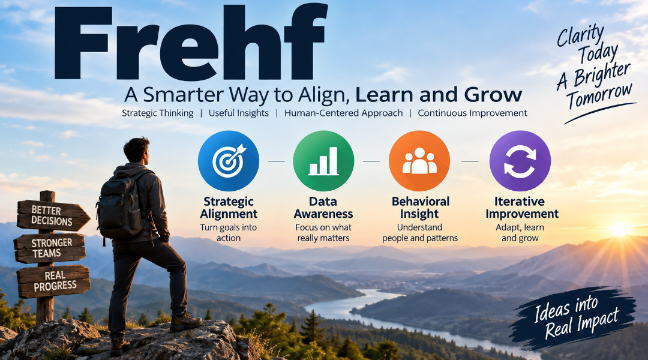
Frehf is currently presented most clearly as a framework for helping individuals and organizations approach goals, decisions, and changing situations in a more structured way. Its official website describes four interconnected pillars: Strategic Alignment, Data Awareness, Behavioral Insight, and Iterative Improvement. Together, these ideas are intended to connect objectives with actions, use relevant information, understand human behavior, and make adjustments over time.
A framework rather than a conventional app
The available primary information does not present frehf as software that users must download or install. Frehf.org specifically says that special software is not required and that the approach can even be applied using basic tools. This distinction is useful because some third-party pages describe the term using broader technology language. Those descriptions should not automatically be treated as evidence of a specific application or commercial platform.
The Four Main Pillars
The framework described by Frehf.org is organized around four areas that are intended to work together rather than independently. The first is Strategic Alignment, which connects goals, resources, and actions. The second is Data Awareness, which emphasizes paying attention to useful signals and feedback rather than simply collecting information. The third is Behavioral Insight, which considers human patterns, motivation, cognitive biases, and friction. The fourth is Iterative Improvement, which focuses on making smaller adjustments as new information becomes available.
Why these pillars matter together
The basic structure is relatively straightforward. A goal provides direction, information helps people understand the current situation, behavioral insight adds human context, and ongoing adjustment allows the plan to change when circumstances change. This makes the framework easier to understand as a process than as a piece of technology.
However, the existence of these four pillars does not by itself prove specific performance improvements or business results. Claims about measurable outcomes should be evaluated separately from the framework’s stated principles.
How Strategic Alignment Works
Strategic Alignment is the first pillar identified by the Frehf project. Its purpose is to connect what an individual or organization wants to achieve with the resources and actions needed to move toward that outcome. In practical terms, this means avoiding situations where daily activities become disconnected from larger objectives.
Turning goals into coordinated actions
For example, a team may have a broad objective but several competing tasks. Alignment encourages the team to identify which activities directly support that objective and which may have less importance. The same basic idea can apply to personal planning.
The concept is not unique to frehf, since goal alignment is already used in many established management and planning approaches. What distinguishes this framework, according to its own description, is the attempt to combine alignment with data, human behavior, and continuous adjustment.
Understanding Data Awareness
Data Awareness is the second pillar. The official description emphasizes decisions based on useful signals rather than noise and refers to feedback and indicators.
More information does not always mean better decisions
People and organizations can easily collect large amounts of information without knowing which parts are actually useful. Data awareness therefore involves asking what information is relevant to the decision at hand and whether it provides meaningful feedback.
This principle can be applied without sophisticated technology. A simple record of completed tasks, customer responses, project delays, or recurring problems may sometimes provide enough information to identify a pattern.
It is important, however, to distinguish the principle from specific claims about measurable improvements. Publicly available independent evidence establishing particular numerical benefits from the framework is currently limited.
The Role of Behavioral Insight
The third pillar focuses on people. Frehf.org describes Behavioral Insight in terms of human patterns, cognitive biases, motivation, and points of friction.
Why human behavior matters
A plan can look excellent on paper and still fail because people do not use it consistently. Employees may encounter unnecessary steps, customers may struggle with a process, or individuals may delay an important task because the process feels difficult.
Considering these factors can make planning more realistic. Instead of asking only whether a system is technically possible, people can also ask whether it is understandable, practical, and likely to be followed.
Behavioral thinking is already an established area across fields such as psychology, organizational management, and user experience. Frehf’s presentation combines this perspective with its other three pillars rather than claiming that behavioral insight itself is a new discipline.
Iterative Improvement and Adaptability
The fourth pillar is Iterative Improvement. The framework describes this as making small, rapid adjustments instead of relying only on large changes.
Learning from feedback
A simple example would be a team testing a new workflow. Rather than waiting several months before reviewing the process, the team could observe what works, identify friction, make a small adjustment, and then evaluate the result.
This approach can be useful when circumstances are changing because a plan does not have to remain fixed. It also encourages people to treat feedback as part of the process rather than as something that arrives only after a project has finished.
Again, iterative improvement is not exclusive to this framework. Similar ideas appear in established approaches to product development, project management, quality improvement, and organizational learning.
Is Frehf the Same as Agile or OKRs?
No. The Frehf website describes the framework as something that can work alongside established methods such as OKRs and Scrum rather than simply replacing them.
A broader organizing approach
Agile methods generally focus on adaptive development and incremental delivery, while OKRs provide a structured approach to objectives and measurable results. Frehf’s own description positions its framework at a broader level, connecting goals, information, human behavior, and improvement.
That distinction should not be interpreted as proof that frehf is formally recognized as a new management standard. There is currently insufficient independent evidence to make that claim.
For readers interested in using the ideas, the sensible approach is to compare them with established methods and determine whether the framework adds practical value to an existing process.
What Is Actually Known About Frehf?
One of the most important things to understand is that information about frehf remains limited. The official project provides a description of its four pillars and explains that the approach does not require special software. However, independent documentation, recognized standards, detailed technical documentation, and broadly established professional recognition are not clearly demonstrated by the sources currently available.
Why caution is important
Several third-party websites give substantially different meanings to the same term. Some describe it as a productivity framework, while others connect it with creativity, artificial intelligence, or digital culture. These interpretations should not automatically be combined into one definition.
There is also no reliable evidence supporting a universally accepted expansion of the name as an acronym. Treating one proposed expansion as definitive would therefore go beyond the available evidence.
How Should Readers Understand Frehf Today?
The safest interpretation is to view frehf as an emerging framework or concept whose clearest documented form focuses on four ideas: alignment, awareness of relevant information, understanding behavior, and continuous improvement. This interpretation comes directly from the project presenting the framework.
Separate the framework from unsupported claims
Readers should be cautious when encountering claims about large-scale adoption, specific performance improvements, famous organizations, or advanced software capabilities unless those claims can be supported by independent, trustworthy evidence.
This does not mean the framework’s ideas are necessarily ineffective. It simply means that the available evidence does not justify presenting every online claim as an established fact.
For someone exploring the concept, the most useful starting point is therefore its actual principles rather than speculative origin stories or exaggerated descriptions.
Practical Ways to Apply the Framework
Because the framework is presented as not requiring special software, its basic principles can theoretically be considered using ordinary planning tools.
Start with a simple process
First, identify the main outcome you want to achieve. Next, determine which information genuinely helps you understand progress. Then consider the human factors that could make the process easier or harder. Finally, review what happened and make appropriate adjustments.
A notebook, spreadsheet, project document, or existing workplace system could support this type of process. The important point is not the tool itself but the connection between goals, information, behavior, and feedback.
Users should also avoid assuming that following a framework automatically guarantees better results. Its usefulness depends on how thoughtfully the principles are applied and whether the chosen process actually fits the situation.
Conclusion
Frehf is an emerging term whose clearest documented meaning is currently connected to a four-part framework covering Strategic Alignment, Data Awareness, Behavioral Insight, and Iterative Improvement. The framework is presented as a practical way to connect goals, information, human behavior, and ongoing adaptation, and its official website states that specialized software is not required. At the same time, independent information remains limited, and different online sources use the term in conflicting ways. For that reason, readers should distinguish the framework’s stated principles from unsupported claims about technology, adoption, origins, or measurable results. Until stronger independent documentation becomes available, a careful and evidence-based understanding is the most useful way to approach frehf.
FAQs
1. What does frehf mean?
Frehf is currently presented most clearly as a structured framework involving strategic alignment, data awareness, behavioral insight, and iterative improvement. Its wider online meaning is not universally established.
2. Is frehf an app or software?
The official Frehf website presents it as a framework rather than software that users must install. It states that special software is not required and basic tools can be used.
3. What are the four pillars of frehf?
The four pillars identified by the official project are Strategic Alignment, Data Awareness, Behavioral Insight, and Iterative Improvement. They are intended to work together as a structured approach.
4. Is frehf an established industry standard?
There is not enough independent evidence to describe frehf as a formally established industry, academic, or government standard. Its current status is better described as an emerging framework or concept.
5. Does frehf have one official meaning?
Not across the entire web. Different sources use the term differently. The clearest identifiable definition comes from Frehf.org, which presents it as a four-pillar framework for clarity, performance, and adaptability.